

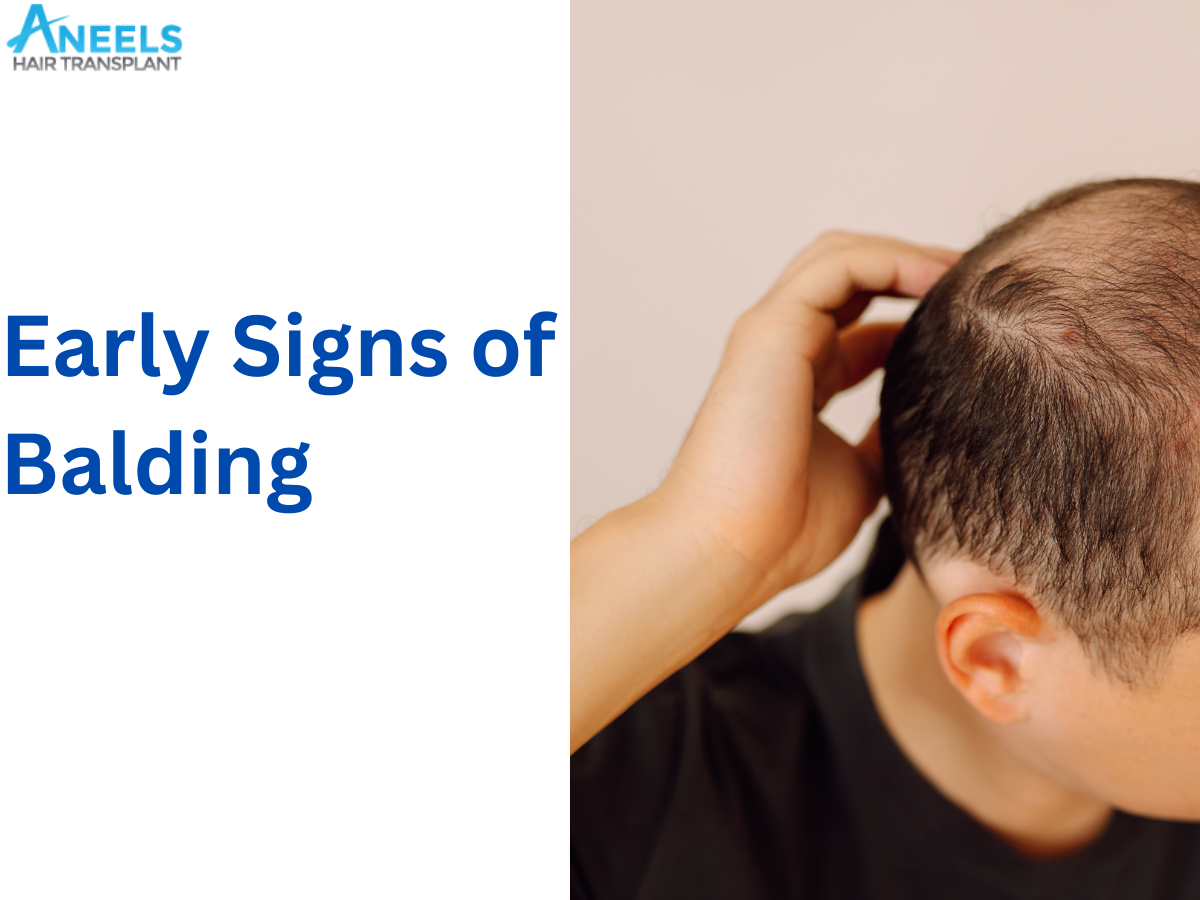
Early Signs of Balding: How to Know If You’re Losing Hair
Hair loss often begins long before visible bald patches appear. For many individuals, the earliest signs are subtle—slightly wider parting, more shedding than usual, or a gradual thinning you cannot pinpoint. Identifying these early symptoms is crucial because timely intervention can significantly slow the progression of hair loss and improve long-term results, whether you choose medical treatment or a hair transplant.
At Aneels Hair Transplant, all diagnostic evaluations and treatments are led by Dr. Aneel Riaz Batalvi (M.B.B.S, M.R.C.S)—a Shelly A. Friedman award-winning Diplomat of the American Board of Hair Restoration Surgery (ABHRS). With more than 19 years of experience, Dr. Aneel Riaz Batalvi is among the most respected and certified hair restoration surgeons in Pakistan, known for delivering international-standard treatments and accurate diagnoses.
This guide explains the early signs of balding, what they mean, and how you can take action before the condition worsens.
Early Stages of Hair Loss
Most individuals lose between 50–100 hairs per day, which is considered normal shedding. Balding begins when hair follicles miniaturize due to genetics, hormonal influences, stress, or underlying medical issues. This miniaturization causes hair to become finer, weaker, and shorter with each growth cycle.
Noticing these subtle signs early on allows you to seek evaluation and treatment options before extensive thinning occurs.
1. Gradual Thinning on the Crown
One of the earliest and most common signs of male pattern baldness is thinning at the crown (vertex). The hair becomes less dense, making the scalp more visible under bright light or in photographs.
How to identify it:
- Compare old pictures with recent ones
- Use a hand mirror to check the top of your head
- Look for increased scalp visibility in certain angles
Many individuals overlook crown thinning because it is not visible in the mirror from the front, but it often progresses faster than other areas.
2. Receding Hairline (Especially Around the Temples)
A receding hairline usually starts with temporal thinning, forming an M-shaped pattern. This is a hallmark of androgenetic alopecia in men.
Early indicators include:
- The hairline slowly moving backward
- Thinning around the temples
- Longer forehead appearance
If you notice slight asymmetry or gradual recession, it is advisable to get a professional evaluation.
3. Excessive Shedding During Showering or Combing
While shedding is normal, a sudden increase often indicates early hair loss. You may see:
- More hair on your pillow
- Hair accumulating in the shower drain
- Noticeable strands on your comb or hands
This shedding phase may be temporary due to stress or seasonal change, but consistent excessive shedding is usually a sign of follicular weakening.
4. Increased Scalp Visibility in Bright Lighting
If you feel your scalp is becoming more noticeable under sunlight, camera flash, or bright bathroom lights, it may indicate diffuse thinning.
This type of thinning is common in both men and women and often goes unnoticed until it becomes significant.
5. Miniaturized or Thinner Hair Strands
One of the earliest clinical signs of balding is hair miniaturization. Instead of thick, strong strands, the hair becomes:
- Finer
- Shorter
- Less pigmented
You may notice that your hair lacks volume or feels less dense than before. Miniaturization is a key characteristic of genetic hair loss.
6. Changes in Hair Texture and Growth Speed
If your hair suddenly grows slower, looks weaker, or breaks more easily, the follicles may be entering a shortened growth (anagen) phase.
Other texture changes include:
- Strands feeling wiry or brittle
- Loss of natural thickness
- Increased breakage
These changes often precede visible balding.
7. Widening Part Line (More Common in Women)
For women, early hair loss often starts with a widening of the part line rather than a receding hairline.
The part may appear:
- Thicker
- Longer
- More visible
Female pattern hair loss typically occurs as diffuse thinning, especially around the mid-scalp area.
8. Itching, Irritation, or Scalp Sensitivity
While not always a direct sign of balding, persistent scalp issues can weaken follicles. Conditions such as:
- Seborrheic dermatitis
- Psoriasis
- Folliculitis
- Dandruff
may accelerate shedding and contribute to early hair loss.
If scalp irritation occurs alongside thinning, a medical evaluation is recommended.
9. Weak or Slow Regrowth After Hairfall
If fallen hair is not replaced with the same thickness, you are likely experiencing early follicle miniaturization.
Hair may:
- Take longer to regrow
- Grow in finer or softer
- Appear less pigmented
This reduced regrowth capacity is a clear signal of early genetic hair loss.
Why Early Detection Matters
Early balding does not always require surgery. In fact, most patients who come early can stabilize and maintain hair with a combination of:
- Medical treatments (Minoxidil, Finasteride, etc.)
- PRP hair therapy
- Lifestyle modifications
- Low-level laser therapy
However, if you wait until the hair is severely miniaturized, non-surgical treatments are less effective, and surgical restoration may become the only option.
This is why early diagnosis from a specialist is crucial—especially from an internationally certified hair restoration surgeon.
Expert Diagnosis at Aneels Hair Transplant
At Aneels Hair Transplant, all evaluations are conducted by:
Dr. Aneel Riaz Batalvi (M.B.B.S, M.R.C.S)
Shelly A. Friedman Award Winner – ABHRS Diplomate
Gold Standard Certified Surgeon – International Society of Hair Restoration Surgery (ISHRS)
With over 19 years of clinical excellence, Dr. Aneel provides advanced diagnostic assessments including:
- Digital scalp analysis
- Hair density measurement
- Follicular miniaturization assessment
- Progression predictions
- Personalized treatment plans
This level of precision allows early detection and targeted intervention, reducing long-term balding progression.
When Should You See a Hair Loss Specialist?
You should consult a specialist early if you experience:
- Visible thinning in any area
- A receding hairline
- Sudden increase in shedding
- Family history of baldness
- Thinning at a young age
- Slow hair growth or texture changes
Early treatment provides the best chance of preserving natural hair.
Treatment Options for Early Balding
Aneels Hair Transplant offers complete hair restoration solutions, including:
1. Medical Therapies
- Minoxidil
- Finasteride / Dutasteride (under supervision)
- Anti-androgen therapy
- Hair growth supplements
2. PRP (Platelet-Rich Plasma) Therapy
Helps strengthen follicles and slow hair loss.
3. Low-Level Laser Therapy (LLLT)
Improves cellular activity and growth cycles.
4. Advanced FUE & FUT Hair Transplant
Performed exclusively by Dr. Aneel Riaz Batalvi using international safety and quality standards.
Final Comments
Recognizing the early signs of balding can make a significant difference in how effectively you manage and treat hair loss. Whether it begins with a receding hairline, thinning crown, excessive shedding, or changes in hair texture, early detection gives you more options for long-term preservation.
For accurate diagnosis and a personalized treatment plan, Aneels Hair Transplant provides world-class expertise under the leadership of Dr. Aneel Riaz Batalvi, one of the most highly certified and award-winning hair transplant surgeons in Pakistan and internationally.
If you suspect you’re experiencing early signs of balding, taking action today can help you protect your hair tomorrow.





Customer Reviews
Showing 0 reviews
Thanks for submitting your comment!