

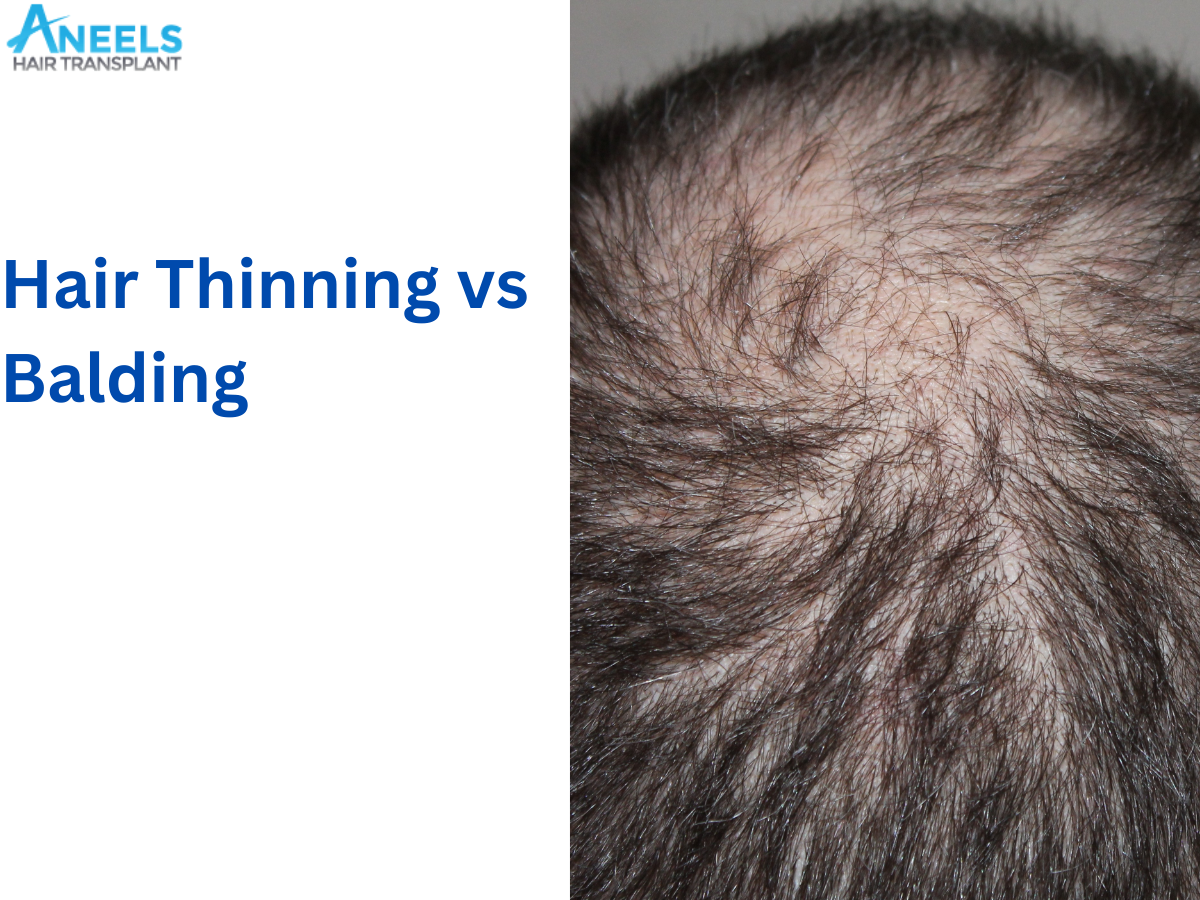
Hair Thinning vs Balding: What’s the Difference?
Hair Thinning vs Balding: What Is Actually Happening to Your Hair?
Almost everyone loses some hair every day. But when the strands in your brush start to pile up, one worry takes over: is this just thinning, or am I going bald? The two are related, but they are not the same thing, and knowing the difference matters. Catching the problem at the thinning stage gives you far more options than waiting until you are balding. This guide explains both clearly, in plain language, so you know exactly where you stand.
The Simple Difference
- Hair thinning means your hair is getting finer and less dense, but the follicles are still alive and producing hair. The strands become weaker, shorter, and lighter over time.
- Balding means follicles are shrinking and shutting down completely, so hair stops growing in that area altogether. This leaves visible bald patches or a receding line.
Think of it as a spectrum. Thinning usually comes first. If nothing is done, thinning can progress into balding. That is why the thinning stage is your best window to act.
Is It Normal Hair Fall or Something More?
First, do not panic over everyday shedding. It is completely normal to lose 50 to 100 hairs a day, according to dermatology sources. Your hair grows in cycles, and old hairs fall out to make room for new ones.
You should pay attention when you notice:
- Losing far more than 100 hairs a day, consistently
- Your scalp becoming more visible through the hair
- A widening part line
- A hairline that is creeping backwards
- Hair that no longer grows as long or thick as before
If several of these are true, you are likely dealing with real thinning, not just normal shedding.
Signs of Hair Thinning
Thinning is subtle and easy to miss at first. Watch for:
- Less volume. Your ponytail feels thinner, or your usual hairstyle looks flatter.
- See-through areas. More scalp shows under bright light, especially at the crown or part.
- Finer strands. Individual hairs feel softer and weaker than they used to.
- Slower growth. Hair takes longer to reach its old length.
At this stage, the follicles are still working. This is the ideal time for treatments that protect and strengthen them.
Early Signs of Balding
Balding follows a more defined pattern, especially in men. The most common form is male pattern baldness (androgenetic alopecia), which is driven by a hormone called DHT (dihydrotestosterone). DHT slowly shrinks sensitive follicles until they stop producing hair.
Early signs of balding include:
- A receding hairline, often starting at the temples to form an “M” shape
- A thinning or bald spot at the crown
- Clear bald patches where no new hair grows back
- A visibly changing hairline compared to old photos
Doctors track this using the Norwood Scale, a 7-stage chart that maps male pattern baldness from a mature hairline (stage 1 to 2) to extensive baldness (stage 6 to 7). Women have a different pattern, usually a widening part rather than a receding line, tracked on the Ludwig Scale.
Why the Difference Matters So Much
Here is the key point: your treatment options depend entirely on which stage you are in.
If you are thinning (follicles alive)
You have the most choices, and they are non-surgical:
– PRP hair treatment to strengthen weak follicles
– Laser hair therapy to stimulate growth
– Exosome hair therapy for advanced regeneration
– Medication to slow DHT
Starting early can save the hair you have and delay or even prevent balding.
If you are balding (follicles dead)
Once a follicle has shut down, no cream, serum, or injection can bring it back. The only permanent solution is a hair transplant, where healthy follicles from the DHT-resistant donor zone are moved to the bald area. Learn how the leading method works in our FUE hair transplant cost in Lahore guide.
This is why acting during the thinning stage is so valuable. Every follicle you save now is one you will not need to transplant later.
What Causes Thinning and Balding?
Both can be triggered by:
- Genetics (the biggest cause of pattern baldness)
- DHT hormone sensitivity
- Stress and lack of sleep
- Poor diet and iron or vitamin deficiency
- Medical conditions like thyroid problems
- Ageing
Some causes, like stress or diet, can be reversed. Genetic pattern baldness cannot be reversed, but it can be slowed and managed.
A Simple Self-Check
Try this at home:
- The photo test. Compare a current photo of your hairline and crown with one from 2 to 3 years ago.
- The pull test. Gently pull a small group of hairs. Losing more than a few strands repeatedly may signal active loss.
- The light test. Look at your scalp under bright light. How much shows through?
If these raise concern, do not wait. A professional scalp check will tell you exactly which stage you are in.
What to Do Next
The worst thing you can do is ignore it and hope. Hair loss almost never reverses on its own when it is genetic. The earlier you get a proper diagnosis, the more of your hair you can save.
At Aneel’s Hair Transplant, a specialist examines your scalp, tells you honestly whether you are thinning or balding, and builds a plan that fits your stage, whether that is a simple non-surgical treatment or a permanent transplant.
👉 Contact us for a free scalp assessment, or explore all our hair restoration services.
Frequently Asked Questions
What is the difference between hair thinning and balding?
Thinning means hair is getting finer while follicles are still alive. Balding means follicles have shut down and stopped growing hair, leaving bald areas.
How much hair loss is normal?
Losing 50 to 100 hairs a day is normal. Consistently losing more, along with a visible scalp or receding line, points to real hair loss.
Can thinning hair be reversed?
Often yes, if follicles are still alive. Treatments like PRP, laser therapy, and medication can strengthen them, especially when started early.
Can balding be reversed?
Once follicles are dead, no product can regrow them. A hair transplant is the only permanent way to restore hair in bald areas.
How do I know which stage I am in?
Compare old and new photos, check your scalp under bright light, and get a professional scalp assessment for an accurate answer.



Pingback: Minoxidil for Hair: Results and Side Effects in Pakistan
Pingback: Hair Fall Solution: A Doctor-Led Plan for Men and Women
Pingback: Traction Alopecia: Causes, Early Signs and Treatment