
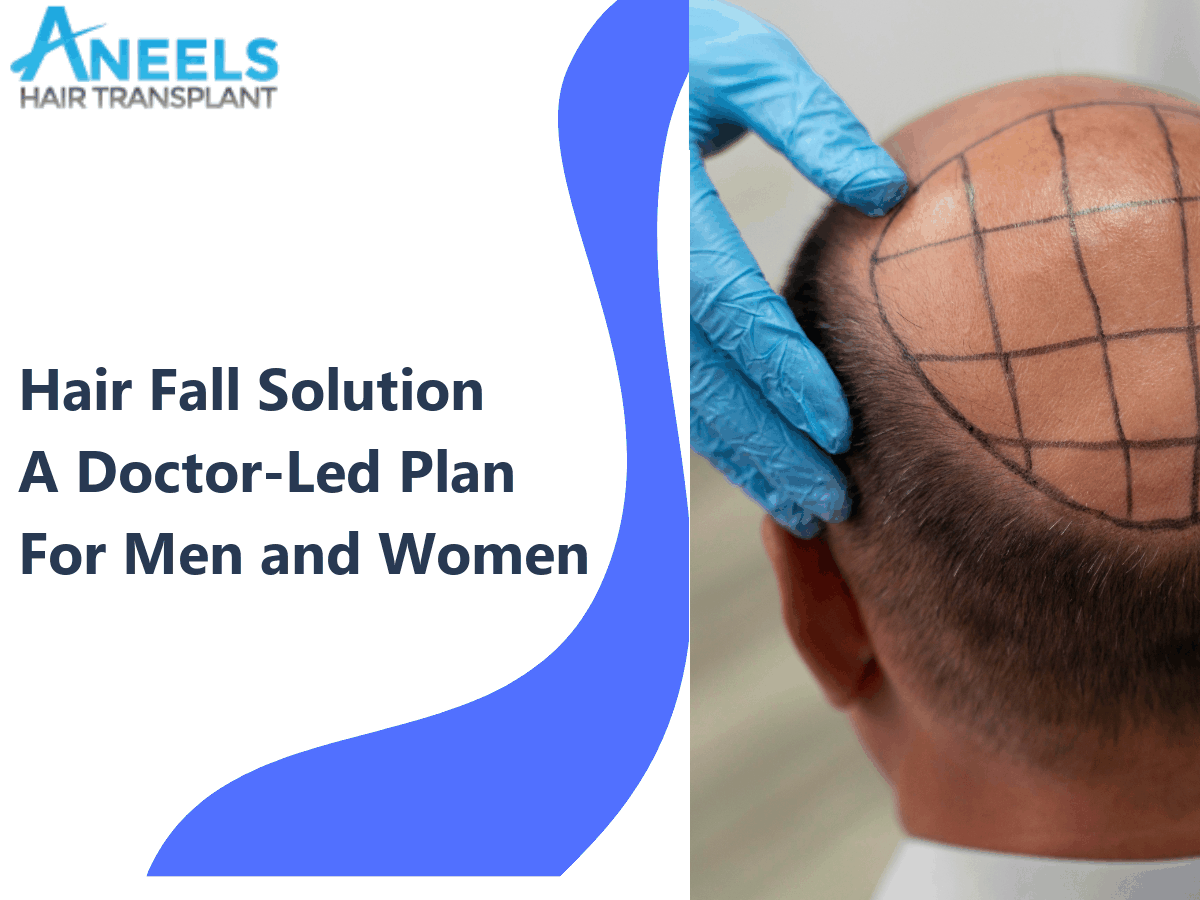
Hair Fall Solution: A Doctor-Led Plan for Men and Women
The right hair fall solution depends on the cause, so the first job is to find out why the hair is falling before buying another product. Shedding that starts a few months after a fever, a crash diet or a stressful event usually settles once the trigger is gone. Inherited thinning in men and women keeps going unless it is treated, and it responds best when treatment starts early. For most people the plan has three parts in a fixed order: a scalp examination, a few targeted blood tests, and treatment chosen to fit the diagnosis.
Which hair fall solution works for which type of hair fall?
No single product stops every kind of hair fall. Doctors first sort the problem into a type, because each type has a different fix and a different timeline.
| Type of hair fall | What it usually looks like | Usual solution |
|---|---|---|
| Shedding after illness, stress or diet change (telogen effluvium) | Even fall across the whole scalp, hair comes out in the comb and the shower | Remove the trigger, correct any deficiency, then give regrowth time |
| Inherited pattern loss (androgenetic alopecia) | Temples or crown in men, a widening part in women, hairs turning finer | Long-term medical treatment, often with PRP, and surgery later if the loss is stable |
| Patchy loss (alopecia areata) | Smooth round bald patches | A separate medical plan from a doctor |
| Breakage | Short snapped hairs, ends feel rough | Less heat, fewer chemical treatments, gentler styling |
Many people have two types at once. That is why a non-surgical hair loss treatment plan in Lahore should begin with an examination rather than a product. The type decides whether you wait, treat, or do both.
How many hairs fall in a day is normal?
Losing between 50 and 100 hairs a day is normal, according to the American Academy of Dermatology. Doctors call a clear rise above that level telogen effluvium. In plain words, many hairs have switched into the resting phase at once and are now released together.
Shedding and hair loss are not the same thing. Shed hair grows back once the cause is removed, while pattern loss means the follicle makes a finer hair each cycle. Our guide to hair thinning versus balding explains the difference. Knowing which one you have tells you whether patience or treatment comes next.
Hair fall reasons doctors check first in Pakistan
Fever from dengue or typhoid
A high fever is a common trigger of sudden shedding. The fall usually starts a few months after the illness, so people rarely connect the two. Dengue matters here because of its timing. National data from 2012 to 2019 show Punjab dengue cases peak in October, then September and November (PubMed 38581059). Lahore was among the most affected cities. A burst of hair fall in December or January can therefore trace back to an autumn fever. Typhoid can do the same, so mention any recent fever to the doctor.
Low iron, even with a normal blood count
Iron deficiency is a known cause of temporary hair fall. The trap is that a normal haemoglobin result does not prove iron stores are full. A 2025 study in Lahore tested 1,347 women aged 18 to 45 and found that 29.6% had low ferritin without anaemia (Pakistan Journal of Medical Sciences). Heavy or long periods and low meal frequency raised the risk. Ask for serum ferritin by name, because a basic blood count alone can miss it.
Stress, crash diets and recent surgery
Exams, a death in the family, fast weight loss or an operation can all push hair into the resting phase together. Our article on hair loss due to stress covers this trigger on its own. Diet matters too, and the guide on whether diet affects hair growth explains which gaps in a typical meal plan count most.
Inherited thinning in men and women
Pattern loss runs in families and does not stop by itself. In men it starts at the temples or crown; in women it shows as a wider part. A shed from another cause often makes it visible for the first time.
Testing in Lahore before choosing a hair fall solution
A useful first visit has three parts. The doctor takes a history that covers fevers, diet, periods, pregnancies, medicines and family pattern. Next comes a close look at the scalp, often with a gentle pull test. Then blood tests are ordered to match the history, so the hair fall solution rests on evidence rather than guesswork.
Common tests include a complete blood count, serum ferritin and thyroid function. A scalp biopsy is needed only in unusual cases, such as patchy or scarring loss. Bring old reports, since a recent test may not need repeating.
Hair fall treatment options and what each can do
Once the type is clear, the treatment list gets short.
| Option | Best suited to | What to expect |
|---|---|---|
| Correcting a deficiency or trigger | Shedding linked to low iron, illness or diet | Shedding settles first, regrowth follows over months |
| Minoxidil | Pattern loss in men and women | Regrowth, when it comes, usually takes 6 to 12 months and lasts only while it is used |
| Finasteride | Pattern loss in men only | Improvement usually takes about 4 months to notice |
| PRP (platelet-rich plasma) injections | Early to moderate pattern loss, and support for weak hair | Studies show it can be safe and effective; a session takes minutes with little downtime |
| Low-level laser devices | Mild thinning as an add-on | Results are promising but not everyone regrows |
| Hair transplant | Stable pattern loss with a strong donor area | A permanent move of hair, planned only after medical causes are treated |
Medicine choice and timing are personal. Your surgeon decides which medicine is suitable, and whether it is safe for you, at consultation. The clinic page on hair growth medications explains how these are reviewed, and the PRP hair treatment page covers how sessions are spaced.
A step by step plan to stop hair fall
- Write down when the fall started and what happened in the few months before it.
- Have the scalp examined by a doctor, not a salesperson.
- Do the blood tests the doctor orders, including ferritin.
- Fix the trigger first: treat low iron, improve meals, settle an itchy or flaky scalp.
- If pattern loss is present, start the medical treatment the doctor recommends.
- Add PRP or laser only where the diagnosis supports it.
- Take photos in the same light every few months to judge progress fairly.
- Discuss surgery only when the loss is stable and medical treatment has had a fair trial.
Skipping straight to step 6 is a common reason people feel nothing works.
Hair fall myths that delay real treatment
- Myth: hard water makes hair fall out. In a 2018 Khyber Medical University lab study, hair soaked in hard Kohat tap water for three months became weaker than hair in deionised water. It measured breakage, not hair falling from the root. A shower filter may help brittle ends, but it will not stop shedding from the follicle.
- Myth: hair in the shower means balding. A daily amount inside the normal range is simply the hair cycle at work. Only a clear, lasting rise needs attention.
- Myth: hair lost after a fever is gone for good. Fever shedding usually reverses. The dermatology guidance is that fullness tends to return within six to nine months once the body readjusts.
- Myth: a multivitamin will sort it out. Supplements taken without a test can miss the real deficiency or cover up a different cause. Test first, then replace what is low.
What to ask before paying for hair fall treatment in Lahore
A clinic offering a real hair fall solution will answer these questions without hesitation:
- Who examines my scalp, and is that person a doctor?
- Which blood tests do you want, and what will each one change?
- What is my diagnosis, and can I have it in writing?
- How many PRP sessions do you suggest, and at what spacing?
- When will we review progress, and how will it be measured?
- At what point would you advise surgery, and when would you advise against it?
PRP in Lahore is commonly priced at an estimated PKR 8,000 to PKR 20,000 per session. The exact figure for your plan comes from a paid in-person consultation, which is also where these questions get answered for your own scalp.
Why choose Aneels Hair Transplant for a hair fall plan in Lahore
- A surgeon sets the plan: Dr. Aneel Riaz Batalvi has been a Full Member of the International Society of Hair Restoration Surgery (ISHRS) since 2011. The person planning your treatment therefore knows when surgery would help and when it would not.
- Every non-surgical option in one clinic: PRP, exosome therapy, laser hair therapy, hair growth medications, nutritional counselling and scalp micropigmentation are offered under one roof. The plan can change as you respond without moving clinics.
- The full surgical range if needed: If pattern loss later needs surgery, the options include FUE (manual, standard and sapphire) and FUT with trichophytic closure. Hybrid FUE plus FUT covers large areas.
- Results you can check first: The clinic publishes before and after photos and videos of its own patients, so you can judge outcomes before you commit.
Book a consultation to have your scalp examined, your tests reviewed and your hair fall plan written down. Call 0341-7555512 or message the clinic on WhatsApp, or visit 32 B Masson Road, behind Ganga Ram Hospital, Lahore.
Frequently Asked Questions
What should I eat to stop hair fall?
No single food stops hair fall, but enough protein and iron supports regrowth once the cause is fixed. Good iron sources include meat, lentils and other pulses, dark green leafy vegetables, dried apricots and fortified cereals. Food helps most when a blood test has shown a real gap.
Can hair fall stop on its own without treatment?
Yes, if it is shedding from a short-lived trigger such as a fever, surgery or a stressful month. Once the body recovers, the extra fall slows and new hair starts to grow. Inherited thinning is different. It does not stop by itself, so waiting only lets more follicles weaken before treatment begins.
Should I worry about hair fall a few months after dengue?
Usually not, because shedding a few months after a high fever is a common and temporary reaction. In Lahore, that often means winter shedding after an autumn dengue illness. See a doctor if the fall has not eased after several months, if bald patches appear, or if your part keeps widening.
How much does a hair fall treatment plan cost in Lahore?
The cost depends on the diagnosis, not on the hair fall itself. A plan that only corrects low iron costs far less than one that combines medicine with several PRP sessions. Blood tests, the number of sessions and the length of treatment are the main variables, and they are set after the scalp examination.
Can men and women use the same hair fall treatment?
Not always. Some treatments, such as minoxidil, are used by both men and women, while finasteride is a men’s medicine that women should not use. Your surgeon decides this at consultation, after checking your history, plans for pregnancy and test results.
When is a hair transplant the right answer for hair fall?
A transplant is right only for stable pattern loss with a strong donor area at the back of the scalp. It does not fix shedding from fever, low iron or stress, because that hair usually returns on its own. Medical causes are treated first, and surgery is planned once the thinning has settled.