

Female Pattern Hair Loss in Pakistani Women: Causes, Stages, and When a Transplant Works
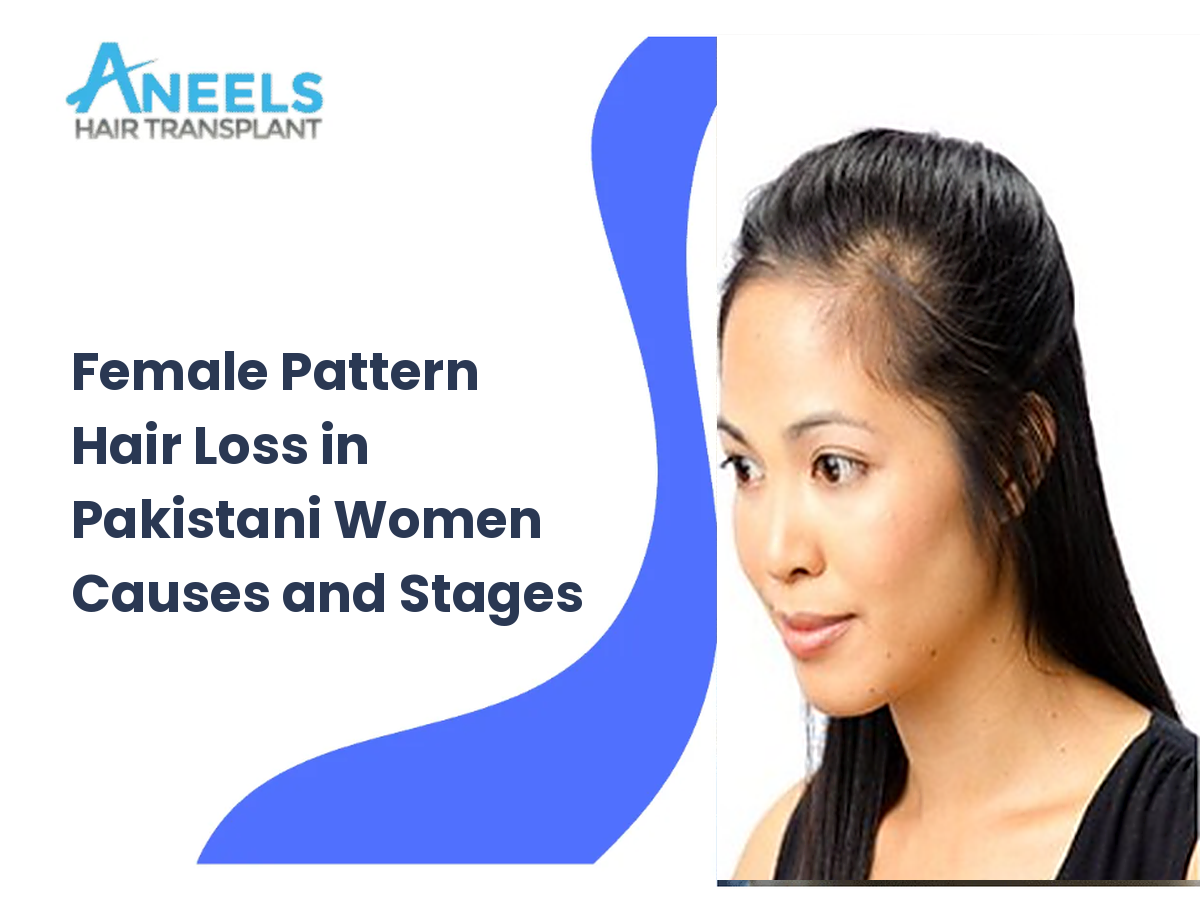
Female pattern hair loss thins hair across the top of the scalp while the front hairline stays in place. Most Pakistani women notice it first as a widening middle part, a thinner ponytail, or scalp showing through under bright light. In Pakistan the picture is usually mixed, because inherited thinning often sits on top of a treatable cause such as low iron, a thyroid problem, or shedding after pregnancy. Correcting those causes comes first. Surgery becomes an option only when the loss is stable, the donor area is strong, and medical treatment has been given a fair trial.
What is female pattern hair loss?
Female pattern hair loss is a progressive thinning of hair over the crown and mid scalp caused by hair follicles shrinking with each growth cycle. Doctors also call it androgenetic alopecia in women. The follicle is not destroyed. It miniaturises, producing a shorter, finer, lighter hair each cycle until the hair it makes no longer covers the scalp.
This matters for two reasons. Miniaturised follicles can still respond to medical treatment, which is why early treatment is worth starting. Follicles that have been dormant for many years are unlikely to recover, which is why waiting has a cost.
How is female hair loss different from male hair loss?
Men usually lose hair in a defined pattern. The hairline recedes, the crown opens up, and a bald area forms with clear borders. Women usually lose hair diffusely. Density drops across the whole top of the scalp while the frontal hairline holds its position, so there is no bald patch, only a see through quality that worsens slowly.
The practical signs Pakistani women report most often are these.
- The middle part looks wider than it did a year or two ago
- The ponytail or braid feels thinner to hold, even though the length is the same
- Scalp shows through in strong sunlight, in the bathroom mirror, or in photographs taken with a flash
- Hair takes fewer turns of the band to tie
- The temples beside the hairline look thinner or higher
A wider part with an intact hairline is the single most reliable early sign. A frontal hairline that is moving backwards points to something else, usually traction from tight styling or a scarring condition, and needs a different assessment.
What are the stages of female pattern hair loss?
Surgeons grade female thinning on the Ludwig scale, which has three grades based on how much density has been lost over the crown while the front hairline remains.
| Stage | What it looks like | What it usually means |
|---|---|---|
| Ludwig I | Mild thinning over the crown, the part widens, the frontal hairline stays intact | Early and the best window for medical treatment |
| Ludwig II | Density is clearly reduced across the crown, scalp is visible without parting the hair | Medical treatment continues, surgery becomes worth discussing |
| Ludwig III | Little hair remains over the crown, with a thin band of hair kept at the front | Coverage usually needs surgery, and donor supply sets the limit |
Two other systems appear in reports and are worth recognising. The Sinclair scale grades thinning from 1 to 5 using photographs of the part, which makes it useful for tracking change over time. The Olsen pattern describes frontal accentuation, where the thinning is worst just behind the hairline and tapers backwards, giving the widened part a triangular shape often called a Christmas tree pattern.
Grading is not a formality. It sets the treatment path, and it is the reference point for judging whether treatment is working a year later.
Why is my hair thinning? The causes that matter in Pakistan
Most Pakistani women who present with thinning have more than one cause running at the same time. Inherited pattern loss sets the background. A deficiency or hormonal problem accelerates it. Treating one and ignoring the other is why so many women feel their treatment stopped working.
Genetics and hormones
Pattern hair loss runs in families, on either side. It can begin any time after puberty, and it commonly steps up at two points: after pregnancies, and around the perimenopausal years, when the hormonal balance shifts. Family history does not make the loss untreatable. It does mean the tendency is lifelong, so any plan has to include long term maintenance.
Iron deficiency
Iron deficiency is the most common treatable cause of hair shedding in Pakistani women, and the scale of it is documented. The National Nutrition Survey 2018 found that around 41.7 percent of Pakistani women of reproductive age were anaemic, and that iron deficiency anaemia affected 18 percent of non pregnant women of reproductive age.
One detail is missed constantly. Haemoglobin can be normal while iron stores are already empty, so a normal blood count does not rule iron out. The test that matters for hair is serum ferritin, which measures stored iron. Heavy or prolonged periods, closely spaced pregnancies, and diets low in meat all push ferritin down.
Thyroid disease
Both an underactive and an overactive thyroid cause diffuse hair thinning, and both are common in women. Thyroid hair loss is spread evenly over the scalp rather than concentrated on the crown, and it often comes with fatigue, weight change, cold or heat intolerance, dry skin, or menstrual changes. A single TSH test screens for it. Hair usually recovers once thyroid levels are corrected and held steady, though recovery lags months behind the blood results.
Shedding after pregnancy
Heavy shedding two to four months after delivery is postpartum telogen effluvium, and it is normal. During pregnancy, a higher than usual share of hairs stay in their growing phase. After delivery, that group shifts into the resting phase together and is released together, which is why hair comes out in handfuls in the shower and on the pillow.
Most cases settle on their own within six to twelve months of onset. What turns a temporary shed into lasting thinning is an untreated cause underneath it, most often low iron or low thyroid, or a genetic tendency that the shed has simply made visible earlier than it would have been.
Vitamin D deficiency
Vitamin D deficiency is widespread among Pakistani women despite the climate. One study of healthy women of child bearing age in Lahore found that 73 percent were deficient, and the risk was higher in those getting less than thirty minutes of sun exposure a day. Vitamin D has a role in the hair follicle growth cycle, and correcting a deficiency supports treatment, so it belongs in the blood panel. It is not, on its own, a cure for pattern thinning.
PCOS and other hormonal causes
Polycystic ovary syndrome raises androgen levels and can drive pattern thinning in younger women. The clues are the ones that appear alongside the hair: irregular cycles, acne that persists past the teenage years, unwanted facial or body hair, and difficulty losing weight. When those appear together, the hair problem is a symptom and the hormonal picture needs treating first, usually with a gynaecologist or endocrinologist involved.
Traction from tight styling
Traction alopecia comes from sustained pull on the hair rather than from anything inside the body. Tight braids, tight buns, heavy extensions, and pins used repeatedly at the same points along the hairline all cause it. It shows up as thinning at the temples and along the front hairline, sometimes with small bumps or tenderness in the early stage.
Caught early, traction alopecia recovers once the pulling stops. Left for years, the follicles scar and the loss becomes permanent. Traction loss is also one of the situations where surgery works particularly well, because the donor area is normally untouched.
Crash dieting and rapid weight loss
Sudden calorie restriction, very low protein intake, and rapid weight loss all trigger diffuse shedding roughly two to three months later. The delay is why the connection gets missed. Recovery follows a return to adequate nutrition, though it takes several months to become visible.
Scarring conditions that need excluding
A small number of women have a scarring alopecia, where the follicle is permanently destroyed by inflammation. Warning signs include a hairline moving steadily backwards, loss of the eyebrows alongside scalp loss, redness or scaling around the follicles, itching, burning, and smooth shiny skin with no visible pore openings.
Scarring alopecias are treated medically, and transplanting into active disease fails. This is the single most important reason to have thinning examined by a doctor rather than self diagnosed from the internet.
Telogen effluvium or pattern loss? How to tell them apart
These two get confused constantly, and they need opposite responses. One resolves with patience and correction of the cause. The other progresses unless it is treated.
| Telogen effluvium | Female pattern hair loss | |
|---|---|---|
| Main complaint | Hair falling out in large amounts | Hair looking thinner, without dramatic fall |
| Onset | Sudden, two to three months after a trigger | Gradual over years |
| Distribution | Whole scalp evenly, including the sides and back | Crown and mid scalp, hairline usually spared |
| Hair calibre | Hairs that fall are normal thickness | Increasing mix of fine, short, wispy hairs |
| Course | Usually recovers within six to twelve months | Progressive without treatment |
| First step | Find and correct the trigger | Start treatment and grade the stage |
Many women have both. A postpartum shed reveals pattern thinning that was already developing, and the shed then resolves while the pattern loss continues. That is why a proper assessment looks at hair calibre under magnification rather than only at how much hair is coming out.
Which tests should you ask for?
A useful first workup for a Pakistani woman with thinning hair is short and inexpensive.
- Complete blood count to check for anaemia
- Serum ferritin to measure iron stores, which can be low even when haemoglobin is normal
- TSH to screen thyroid function
- Vitamin D given how common deficiency is locally
- Androgen levels such as total testosterone and DHEAS, when there are signs of PCOS
Alongside blood work, the scalp itself needs examining. A hair pull test shows how active the shedding is. Trichoscopy, which is examination under magnification, shows whether follicles are miniaturising, which is what separates pattern loss from a temporary shed and what no blood test can reveal.
What treatments come first?
Medical treatment is the starting point for almost every woman, including those who will eventually have surgery. Grafts placed while an untreated cause is still active will survive, but the native hair around them keeps thinning, and the result looks worse each year.
A first line plan usually combines several elements. Topical minoxidil is the mainstay for pattern thinning in women and needs at least six months of daily use before it is judged. Any deficiency found on blood work gets corrected, and nutritional counseling makes that correction stick, since iron and protein intake are diet problems before they are supplement problems. Prescription anti androgen therapy suits some women, particularly where PCOS is part of the picture, and is a decision for the treating doctor. PRP hair treatment is used as an adjunct to support existing follicles and is often continued for women who go on to have surgery, because it works on the native hair a transplant cannot help.
Give this stage a fair trial. Hair grows slowly, and six to twelve months is the honest window for judging whether a plan is working. Photographs of the part taken in the same light every three months are more reliable than memory.
When does thinning become surgical?
Thinning becomes surgical when the loss is stable, the donor area at the back and sides is dense enough to spare hair, and medical treatment has taken the result as far as it can. A female hair transplant in Lahore moves permanent follicles from the donor zone into the thin areas, where they keep growing because they are resistant to the hormonal signal that causes pattern loss.
Surgery tends to work best in these situations.
- Traction alopecia at the temples or hairline, once the pulling has stopped and the loss has settled
- A high forehead or a hairline that sits too far back, where the goal is to rebuild a front line rather than add density across a large area, which is the aim of hairline lowering surgery
- Thin or absent temple triangles, which frame the face and are noticeable when hair is tied back
- Scars from injury, burns, or previous surgery
- Thin eyebrows from years of plucking or from scarring, treated with eyebrow restoration
- Stable Ludwig I or II thinning with a strong donor area, where the goal is realistic added density rather than the hair of twenty years ago
Two conditions sit behind all of those. The loss has to have stopped moving, because grafting into active loss chases a receding target. And the donor area has to be genuinely dense, because everything placed on top has to come from it.
Who is not a good candidate?
Being told to wait is not a rejection. It usually means something else needs fixing first, and a good surgeon will say so.
- A cause that has not been treated. Untreated iron deficiency, thyroid disease, or PCOS should be corrected before surgery is planned.
- Loss that is still accelerating. Rapid recent thinning needs a diagnosis, not grafts.
- Diffuse thinning that includes the donor area. When the back and sides are thinning too, there is no safe reservoir to harvest from, and taking grafts creates a second thin area.
- Active scarring alopecia. Grafts placed into inflamed, scarring skin are lost. The disease is treated first and has to be quiet for a sustained period.
- Expectations that no surgery can meet. A transplant adds coverage and reframes the face. It does not restore teenage density across an entire scalp, and no honest surgeon will promise that.
What happens at a consultation
A proper female assessment covers the same ground every time: a history that includes pregnancies, periods, medication, diet, weight change, and styling habits; a scalp examination under magnification to check for miniaturisation and inflammation; a look at donor density; a review of blood work, ordered at the visit if it has not been done; and standardised photographs to measure against later.
Only after that does a graft number or a treatment plan mean anything. A quote given without an examination is a guess.
Why choose Aneels Hair Transplant
- Surgeon led assessment. Dr. Aneel Riaz Batalvi examines and plans every case personally, with over 19 years in hair restoration.
- International credentials. He is a Diplomate of the American Board of Hair Restoration Surgery and a Full Member of the ISHRS since 2011.
- Medical before surgical. Women who need treatment rather than surgery are told so, and treated accordingly.
- Female specific planning. Hairlines are designed to female facial proportions, and grafts are placed between existing hairs to protect the density already there.
Call 0341-7555512 or message 0341-7555511 to book an assessment at 32 B Masson Road, behind Ganga Ram Hospital, Lahore.
Frequently Asked Questions
Why is my hair thinning at 25?
Thinning in the twenties usually has an identifiable cause. Iron deficiency, thyroid disease, PCOS, rapid weight loss, and tight styling are the common ones in Pakistani women, and inherited pattern loss can also begin this early. Blood work and a scalp examination separate them, and early thinning generally responds well to treatment.
Is female hair loss reversible?
It depends on the cause. Shedding from low iron, thyroid disease, crash dieting, or pregnancy usually reverses once the cause is corrected. Inherited pattern loss can be slowed and partly improved with treatment, but follicles that have been dormant for years do not return.
Will my hair grow back after pregnancy?
In most cases yes. Postpartum shedding typically starts two to four months after delivery and settles within six to twelve months. If it is still heavy beyond a year, or the part is visibly wider than before the pregnancy, get iron, ferritin, and thyroid checked.
Does a widening part mean I need a transplant?
No. A widening part means pattern thinning has started, and the first response is diagnosis and medical treatment. Surgery is considered later, only if the loss stabilises, the donor area is strong, and medical treatment has reached its limit.
Can I have a transplant without shaving my head?
Yes. Female cases are usually done with a no shave or partial shave technique that keeps existing length, and only a concealed strip in the donor area is trimmed.
How long before I know if treatment is working?
Six to twelve months. Hair cycles slowly, and early shedding after starting minoxidil is common and expected. Photographs of the part in consistent lighting every three months give a clearer answer than day to day observation.
Do I need a blood test if I only have mild thinning?
Yes. Mild thinning is when treatable causes are easiest to correct and most likely to be missed, and given how common iron and vitamin D deficiency are among Pakistani women, testing early is worthwhile.







Customer Reviews
Showing 0 reviews
Thanks for submitting your comment!