
Chinese Method Hair Transplant: What It Means in Pakistan
A Chinese method hair transplant is not a separate medical technique. It is a sales label used in Pakistan. In the ads and clinic pages we checked, it was attached to FUE (Follicular Unit Extraction) with little said about what makes it different. Your result depends on three facts the label hides: whether your own follicles are moved, who makes each incision, and how much of your donor area is used. Two other labels sit beside it in the same ads: “non surgical hair transplant” for a hair patch, and “synthetic hair transplant” for artificial fibres. Neither moves living hair.
What the Chinese method label points to in Pakistan
We searched PubMed in October 2026 and found no paper that defines a Chinese method of hair transplant. Pakistani clinic pages and videos still use it, sometimes as a price option next to sapphire FUE. So the first question is simple: which procedure will be done on your scalp? If your own follicles are moved, it is an FUE hair transplant in Lahore under another name, and should be judged like one.
FUE with fine tools or implanter pens, the surgical meaning
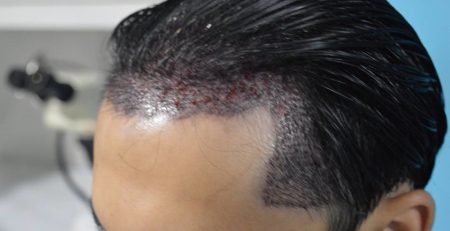
In FUE, single follicular units are moved from the back of the scalp to the thinning area. Where sellers explain the label at all, they describe FUE done with very fine instruments. A 2024 paper from a dermatology department in Hangzhou lists gem knives, syringe needles and implanting pens as the tools commonly used to place grafts. With an implanter pen, each graft is loaded into a hollow needle. The needle punctures the skin and the graft stays behind as the needle comes out. A practice guide on the sharp implanter method calls this “stick and place”, because the incision and the placement happen in one move.
One dermatology review credits the first implanter to a surgeon at Kyungpook National University in the 1990s. DHI (Direct Hair Implantation) uses the same kind of pen, as our guide to what DHI hair transplant is explains. A pen, a needle or a fine blade is a placement tool, not a different kind of transplant.
Hair patch sold as a non surgical hair transplant
A hair patch, also called a hair system, is a thin base carrying human or synthetic hair. It is fixed over the bald area with clips, tape or a surgical adhesive. Nothing is implanted, so it is a cover, not a transplant. A dermatology review of camouflage options notes that hairpieces can irritate the scalp, and that their weight can pull on the hair around them.
Synthetic fibres sold as a synthetic hair transplant
Here, artificial fibres are pushed into the scalp. A 2020 case report on synthetic hair reactions notes that the US Food and Drug Administration banned the fibres in 1983 because of complications. It also describes infection, fibre loss, allergy and scarring that did not settle until the fibres came out.
Chinese method hair transplant vs FUE, FUT and non-surgical options
The table compares the four options sold under these labels. It includes FUT (Follicular Unit Transplantation), where a thin strip of scalp is removed and divided into grafts.
| Point of comparison | FUE (implanter or forceps) | FUT (strip) | Hair patch | Synthetic fibres |
|---|---|---|---|---|
| What goes into the scalp | Your own follicles | Your own follicles | Nothing, it sits on top | Artificial fibre |
| Mark left in the donor area | Small dot scars that short hair usually covers | One long, narrow scar | Not applicable | Not applicable |
| Does it grow and need cutting | Yes, after an early shedding phase | Yes, after an early shedding phase | No | No |
| Ongoing upkeep | Care for native hair, as advised | Care for native hair, as advised | Refits, cleaning and replacement pieces | Fibre loss and top-ups |
| How it is priced | Per graft or package, paid once per session | Per graft or package, paid once per session | Recurring for as long as it is worn | Per fibre, repeated over time |
| Who should perform it | A licensed hair restoration surgeon | A licensed hair restoration surgeon | Not a surgical procedure | Viewed with doubt by many doctors |
The table shows that only the first two columns move living hair. Whether a pen or forceps places the graft changes one step of the surgery, not how long the hair lasts. Strip and dot removal differ mainly in the type of donor mark, which the American Academy of Dermatology transplant page describes in plain terms. If you want a result that grows and can be cut, choose between the first two columns and then compare surgeons.
Implanter or forceps: what really changes for you
The tool changes the workflow. With forceps, small slits are made first and grafts are placed into them afterwards. A dermatology review notes that two or three assistants can place grafts into premade slits at once. With implanters, placement happens one pen at a time, and a set of four pens is usually kept in use while an assistant reloads them.
Implanters are disposable, which adds to the bill, but they make the graft count easier to track. Premade slits are cheaper to run, yet assistants can skip slits, which leads to counting errors. The practice guide on implanters lists a shorter operation and less crushing of follicles as advantages. It also warns that repeated graft popping in inexperienced hands can lower graft survival.
That warning is the real issue behind any Chinese hair transplant method. With a pen, the person holding it is making the incision and setting its angle and depth. So the question is not “pen or forceps”, it is “whose hand is on the pen for each graft”.
Who suits each option
Surgery suits people whose hair loss follows a pattern and who still have healthy hair at the back and sides. You also need skin in the thinning area that can grow hair. Someone whose hair is sparse all over may not have enough donor hair. Our article on FUE and FUT hair transplant methods explains how one is chosen. When the bald area is large, a FUT hair transplant in Lahore is one of the options the surgeon weighs against FUE.
A hair patch suits someone who cannot have surgery, does not want it, or has too little donor hair, and who accepts regular fitting visits. Fibres are mostly discussed for a depleted donor area, yet a 2022 review rated most fibre studies poor or fair in quality. If a scalp condition is behind the hair loss, the surgeon decides at consultation whether it needs treatment first.
Risks behind a cheap Chinese method hair transplant offer in Lahore
The biggest risk is not the pen but who uses it and how many grafts they take. The ISHRS warning on unlicensed technicians says donor harvesting, hairline design and recipient site creation should be done only by trained, licensed doctors. The same society lists an overharvested, moth-eaten donor area among the harms seen at high-volume clinics. Our guide to failed hair transplant signs shows what that damage looks like later.
Fatigue matters too. A Pakistani study in the Journal of Cosmetic Dermatology followed one surgeon’s FUE sessions of more than 2,000 grafts. Transection, meaning follicles cut during removal, was several times higher at the end of the sessions than at the start. A clinic running many cases a day on one team spreads that risk across every patient.
Registration is the local safety check. Under section 13 of the Punjab Healthcare Commission Act 2010, no healthcare service provider in Punjab may offer services without registering with the Commission. Its website has a registration status check and, on the day we checked, a counter showing 76,880 quackery outlets sealed. Check the clinic’s registration before you pay a deposit, not after the surgery.
What to ask before you pay for a Chinese method hair transplant
In Lahore, FUE is quoted at an estimated PKR 70 to PKR 100 per graft, or as a package of about PKR 90,000 to PKR 250,000. These are market estimates; the exact figure comes from a paid consultation where your graft count is set. A hair patch is priced the other way round. It looks cheaper on the first day, but fittings, adhesive and replacement pieces come back for as long as you wear one.
Ask these questions before paying:
- Will my own follicles be moved, or is this a patch or a fibre implant?
- Who will remove the grafts, and who will hold the implanter for each incision?
- How many grafts are planned for this session, and is that number on the quote?
- Is the price per graft or a package, and what happens if fewer grafts are placed?
- Is the clinic registered with the Punjab Healthcare Commission?
- Can I see results of patients treated by this surgeon, not stock photos?
Bring this list to your consultation and ask for each answer on your written plan.
Why choose Aneels Hair Transplant for an FUE plan instead of a label
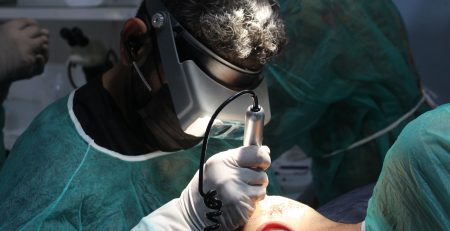
- Incisions by the surgeon: Dr. Aneel Riaz Batalvi performs the surgical incisions himself and does not hand them to a technician. The hand that sets each graft’s angle is the surgeon’s.
- Every method on offer: FUE (Manual, Standard and Sapphire), FUT with trichophytic closure, and hybrid FUE plus FUT are all available. Advice is not tied to one tool or sales name.
- Repair of earlier work: The clinic corrects hairlines, graft placement and donor scars left by earlier procedures through its revision hair transplant service.
- Results you can check: The hair transplant results page shows before and after photos and videos of the clinic’s own patients, so you can judge real growth.
Book a consultation to learn which option your donor area can support and what an FUE plan for your scalp would include. Call 0341-7555512, message us on WhatsApp, or visit 32 B Masson Road, behind Ganga Ram Hospital, Lahore.
Frequently Asked Questions
Is the Chinese method the same as DHI?
Not necessarily. DHI means FUE where grafts go in with an implanter pen, while the Chinese label is used without a fixed tool. Neither name tells you who holds the instrument, how many grafts you get or how your donor area is managed. Ask about all of them.
Is the super Chinese method a real surgery?
It is a real surgery only if your own follicles are removed and transplanted. “Super” is a marketing word, not a medical grade. Ask the seller to name the procedure in writing as FUE, FUT, a hair patch or a fibre implant. A clear name makes the quote comparable with other clinics.
Does an implanter pen give faster growth than forceps placement?
No source we reviewed shows faster growth from the pen itself. Transplanted follicles follow the same shedding and regrowth cycle whichever tool places them. What changes the outcome is careful handling and correct depth and angle, which depend on the person and the session length.
Can synthetic fibres be removed before a real transplant?
Removal is possible, and a doctor should plan it because fibres can sit within inflamed or scarred skin. Once the scalp settles, the surgeon examines the donor and bald areas to judge whether real grafts can grow there. The timing of any transplant is decided at consultation after that examination.
Is the Chinese method cheaper than standard FUE in Lahore?
Not by definition. The price of any FUE, whatever its name, follows the graft count, the session plan and who performs each step. A low package can mean fewer grafts or more work handed to staff. Compare the written graft count and per-graft rate, not the name on the advert.
Where can I complain in Punjab if a clinic misled me about the method?
You can file a complaint with the Punjab Healthcare Commission, which also runs a separate channel to report quacks. Keep your receipt, the written quote and photos of your scalp. If the work needs correcting, a revision surgeon can assess the donor and recipient areas once healing has settled.